Virtual Reality in Education: Transforming Learning Through Immersive Experiences
Introduction
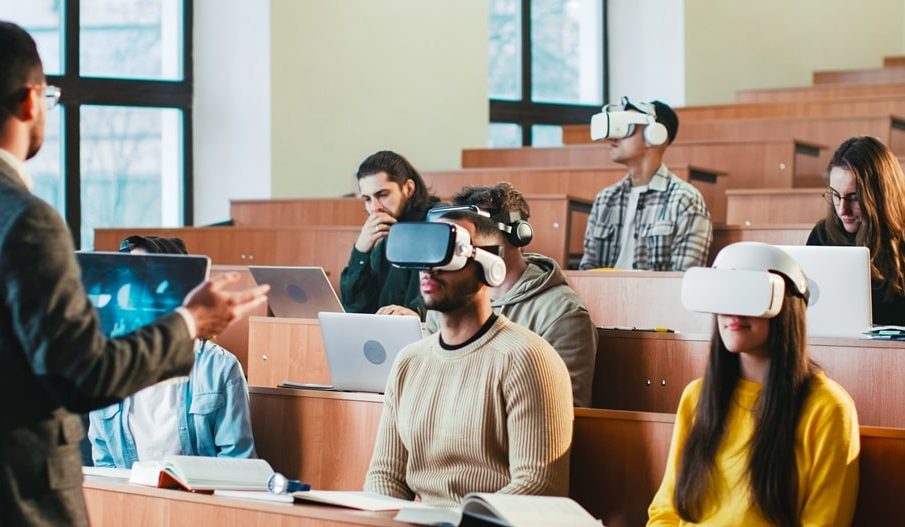
Virtual Reality in education is redefining how learners interact with knowledge by turning abstract concepts into immersive experiences. Instead of passively reading or listening, students can explore environments, conduct simulations, and engage with complex subjects in interactive ways.
As digital transformation accelerates across industries, education systems worldwide are integrating immersive technologies to improve understanding, engagement, and skill development. Virtual Reality is no longer experimental; it is becoming a practical classroom tool that supports both teachers and learners.
What Is Virtual Reality in Education
Virtual Reality in education refers to the use of computer-generated environments that allow learners to experience subjects through simulation rather than traditional instruction methods. With the help of VR headsets and compatible software, students can explore historical sites, travel through the human body, or conduct science experiments in controlled digital environments.
Unlike standard digital learning tools, VR creates a sense of presence. Learners feel as if they are inside the lesson rather than observing it from outside.
Key characteristics include:
- Interactive three-dimensional environments
- Real-time engagement with learning content
- Simulation-based experimentation
- Experiential learning beyond physical limitations
How Virtual Reality Enhances Learning Experiences
Virtual Reality improves learning outcomes by making education more engaging, memorable, and accessible. It allows learners to visualize difficult concepts that are otherwise hard to explain using textbooks alone.
Improves Conceptual Understanding
Students often struggle with abstract subjects such as physics, chemistry, and astronomy. Virtual Reality allows them to observe these concepts in action rather than imagining them theoretically.
For example:
- Exploring molecular structures in three dimensions
- Observing planetary movement in simulated space
- Understanding architectural designs through virtual walkthroughs
Encourages Active Participation
Traditional classrooms sometimes limit interaction. VR transforms learners from observers into participants, increasing attention and retention.
Benefits include:
- Higher engagement levels
- Improved focus during lessons
- Increased motivation to learn independently
Supports Experiential Learning
Experiential learning strengthens memory formation. Virtual Reality enables students to learn through experience rather than memorization.
Examples include:
- Practicing laboratory experiments safely
- Visiting archaeological sites virtually
- Participating in historical events through simulations
Applications of Virtual Reality in Different Educational Fields
Virtual Reality is being used across multiple disciplines to enhance both theoretical and practical learning.
Medical Education
Medical students can practice surgical procedures in simulated environments without risk to patients. This improves confidence and clinical readiness before real-world exposure.
Common uses include:
- Surgical training simulations
- Anatomy visualization
- Emergency response training
Engineering Education
Engineering students benefit from immersive modeling and design environments that allow them to test structures virtually before implementation.
Applications include:
- Structural analysis simulations
- Mechanical system exploration
- Virtual prototyping exercises
History and Social Sciences
Students can experience historical locations and cultural environments instead of reading descriptions alone.
Examples include:
- Visiting ancient civilizations
- Observing historical events through reconstruction
- Exploring world heritage sites virtually
Science Education
Virtual laboratories allow students to perform experiments safely and repeatedly without resource limitations.
Benefits include:
- Reduced equipment costs
- Safe experimentation environments
- Unlimited practice opportunities
Benefits of Virtual Reality in Education
Virtual Reality introduces several advantages that strengthen modern learning systems.
Increased Student Engagement
Immersive experiences capture learners’ attention more effectively than traditional teaching methods.
Safe Learning Environment
Students can practice complex or risky procedures without real-world consequences.
Personalized Learning Opportunities
Virtual environments adapt to individual learning speeds, helping students progress comfortably.
Access to Global Learning Experiences
Students can explore international locations and environments without leaving their classrooms.
Better Knowledge Retention
Experiential learning improves memory retention compared to passive learning methods.
Challenges of Implementing Virtual Reality in Education
Despite its advantages, integrating Virtual Reality into classrooms presents several challenges.
High Initial Investment
Educational institutions must invest in hardware, software, and teacher training before implementation.
Technical Limitations
Reliable infrastructure and technical support are essential for smooth operation.
Teacher Training Requirements
Educators need proper guidance to effectively integrate VR into lesson plans.
Accessibility Concerns
Not all schools currently have equal access to immersive technology resources.
Future of Virtual Reality in Education
The future of Virtual Reality in education is promising as technology becomes more affordable and accessible. Integration with artificial intelligence and cloud-based platforms will further enhance personalized learning experiences.
Expected developments include:
- Wider adoption across schools and universities
- Improved collaborative virtual classrooms
- Real-time global learning interaction
- Expansion of skill-based immersive training programs
As institutions continue embracing digital innovation, Virtual Reality will likely become a standard component of modern education systems.
Best Practices for Integrating Virtual Reality in Classrooms
Successful implementation requires strategic planning and proper support systems.
Recommended approaches include:
- Training teachers before introducing VR lessons
- Aligning VR content with curriculum objectives
- Starting with pilot programs before full deployment
- Ensuring technical infrastructure readiness
- Monitoring student learning outcomes regularly
These steps help institutions maximize the effectiveness of immersive learning tools.
Frequently Asked Questions
1. Can Virtual Reality replace traditional classrooms completely
Virtual Reality is designed to enhance classroom learning rather than replace traditional teaching methods. It works best when integrated alongside existing instructional approaches.
2. Is Virtual Reality suitable for younger students
Yes, age-appropriate VR content can support curiosity-driven learning among younger learners when used under proper supervision.
3. How does Virtual Reality support distance education
Virtual Reality enables remote learners to participate in interactive simulations and collaborative environments similar to physical classrooms.
4. What equipment is required to implement Virtual Reality in schools
Basic requirements include VR headsets, compatible devices, educational software platforms, and stable internet connectivity.
5. Does Virtual Reality improve student performance in examinations
Research indicates that immersive learning improves conceptual clarity and retention, which can contribute positively to academic performance.
6. How can teachers prepare for using Virtual Reality in lessons
Teachers can attend professional development programs, explore VR-compatible lesson plans, and practice using simulation tools before classroom implementation.
7. Is Virtual Reality useful for vocational training programs
Yes, vocational education benefits significantly from simulation-based training that allows learners to practice technical skills in realistic virtual environments without safety risks.