How to choose the right industrial piping solutions for your project
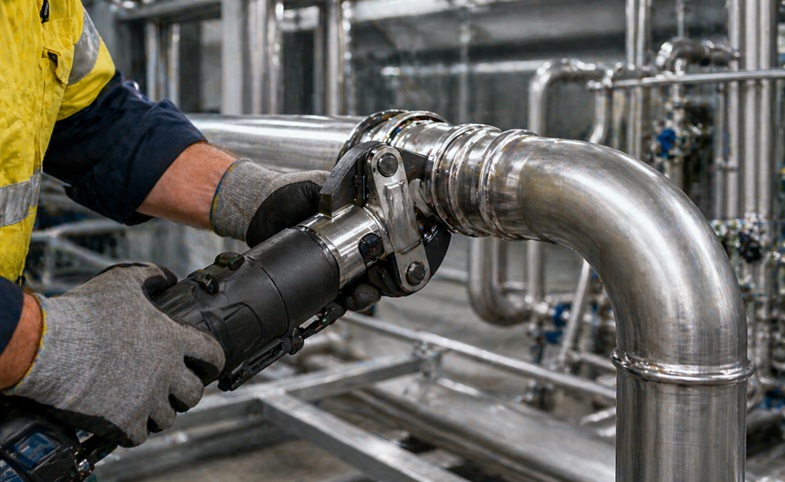
The quick version: Choosing the wrong piping system doesn’t just cost money — it creates safety risks, project delays, and maintenance problems that follow you for the life of the installation. This article covers the factors that determine which piping solution is right for your application, how press-fit technology compares to traditional welding, and what to consider when specifying large-bore steel pipe for high-demand environments.
A piping system that works well disappears into the background. Nobody notices it. It handles pressure, temperature, and flow without incident, year after year, requiring minimal maintenance and zero unplanned downtime.
A system specified poorly — or installed incorrectly — is a different story. Unexpected leaks, corrosion failures, non-compliant joins, and costly remediation work follow decisions made early in the project. By the time the problems surface, the decisions that caused them are often months old and buried under layers of completed work.
For tradespeople, engineers, architects, and project owners across Australia’s industrial and commercial sectors, the choice of piping system is one of the most consequential decisions on any build. This article walks through the core factors that should drive your selection — from material and pressure ratings through to installation method, compliance requirements, and long-term cost.
Why material selection matters more than most people realise
Pipe is pipe until it isn’t. The material a system is made from determines how it performs under pressure, how it responds to temperature change, how resistant it is to corrosion, and how long it lasts before maintenance is needed.
For industrial and commercial applications across Australia, stainless steel has become the dominant material choice across a growing range of uses — and for good reason. Compared to carbon steel and copper, stainless steel offers superior corrosion resistance, reliably handles high pressures and extreme temperature ranges, and maintains the hygienic properties required for food processing, pharmaceutical, and potable water applications.
The two most common grades in Australian industrial piping are 304L and 316L. Grade 316L includes molybdenum, giving it enhanced resistance to pitting and crevice corrosion — particularly in chloride-rich environments such as coastal sites or chemical processing plants. Grade 304L is a cost-effective alternative where chloride exposure is limited and the application doesn’t demand the full corrosion resistance of 316L.
The wrong grade in the wrong environment will corrode prematurely, creating safety risks and replacement costs that far exceed any initial saving on material. Getting the grade right at specification stage is one of the cheapest decisions you’ll make on a project.
Press-fit versus welding: a practical comparison
Traditional pipe welding has been the industry standard for decades. It works — but it carries a significant cost and complexity overhead that press-fit technology has made redundant for a wide range of applications.
The case for press-fit is straightforward. Installation is more than 10 times faster than conventional welding, requires no hot work permits, generates no fumes or arc hazard, and doesn’t require specialist welding qualifications to complete. For project managers working to tight timelines in occupied buildings, or in environments where open flames create safety concerns, those advantages are substantial.
On a busy industrial site, eliminating hot work permits alone removes a layer of administrative complexity and scheduling friction. Factor in reduced labour hours, no consumables, and faster completion, and the economics of press-fit over welded systems are compelling for the majority of commercial and industrial installations.
The range of industrial piping solutions available through press-fit technology now covers a wide range of applications and pressure ratings — and the argument that welding is required for serious industrial work is increasingly difficult to sustain.
For site managers and project owners who’ve historically defaulted to welded systems, the conversation is worth revisiting. The question isn’t whether press-fit can match welded performance — it’s whether you’ve checked current specifications and pressure ratings before assuming it can’t.
Specifying large bore steel pipe: what changes at greater diameters
Most of the conversation around press-fit systems focuses on smaller diameter applications — the 15mm to 54mm range common in commercial plumbing, gas, and fire service. But the technology has expanded, and large bore steel pipe is now a viable press-fit application across much of the infrastructure market.
Large bore press-fit systems covering sizes from 49mm through to 168mm open the technology as an option for municipal water supply, large-scale industrial installations, and heavy-duty pipelines where conventional wisdom once dictated welding as the only approach.
At these diameters, the advantages of press-fit installation are amplified. Labour savings on large bore welded joins are significant, and the risk profile of hot work in complex industrial environments — fuel storage facilities, process plants, confined spaces — makes the weld-free approach not just convenient but a genuine improvement to the project safety profile.
When specifying large bore applications, the variables to confirm are pressure rating, the appropriate O-ring material for the media being transported, and the pipe grade suited to the installation environment. A 316L stainless steel large bore system rated to 25 bar covers the vast majority of high-flow water and gas infrastructure requirements — but getting the specification right for your specific application requires a detailed conversation with a supplier who knows the product range.
Compliance and certification: what you need to verify
Australian industrial and commercial piping projects are subject to regulatory requirements that vary by application, state, and media. Getting compliance wrong results in failed inspections, costly rework, and in the worst cases, serious safety incidents.
For potable water applications, WaterMark certification is non-negotiable. Any pipe or fitting used in a drinking water system must carry WaterMark approval and be installed in accordance with relevant plumbing standards. Gas applications require Gas Approval. Fire protection systems must comply with AS 2118 and related standards.
When evaluating suppliers, ask for documentation. A reputable supplier provides full certification records, compliance documentation, and test reports for every product in their range. If that documentation isn’t readily available, treat it as a flag worth taking seriously before anything goes into the ground.
Total installed cost: looking beyond the unit price
The most common mistake in piping system procurement is optimising for unit price rather than total installed cost. A cheaper product that takes longer to install, generates more waste, requires specialist labour, or fails prematurely will cost more across the life of the project than a premium product that goes in cleanly and reliably.
Total installed cost includes materials, labour, consumables, permits, inspection time, and the cost of any rework if something goes wrong. Press-fit systems consistently perform well on this measure because their installation speed and simplicity reduce the labour component — often the largest variable in the equation.
For large industrial and commercial projects, running the comparison explicitly before specification is locked in is worth the effort. Labour savings from a press-fit system at scale can offset a higher material cost with room to spare, and the reduced OH&S overhead of eliminating hot work has a value that doesn’t always appear in the procurement calculation but absolutely appears in the project risk register.
Frequently asked questions
What applications are stainless steel press-fit industrial piping solutions suitable for?
Press-fit systems are suitable for a wide range of applications, including potable water, hot and cold water systems, natural gas, compressed air, fire protection, hydrocarbons, chemicals, bio-gas, and diesel fuel. Specific suitability depends on the steel grade, O-ring material, and pressure and temperature requirements of the system. Confirming compatibility with your supplier before specification is always recommended.
What is the difference between 304L and 316L stainless steel pipe for industrial use?
Grade 304L is a versatile, cost-effective austenitic stainless steel suited to general industrial and commercial applications where chloride exposure is limited. Grade 316L adds molybdenum, providing enhanced resistance to pitting and crevice corrosion — making it the preferred choice for marine environments, chemical processing, and chloride-rich applications. For most potable water and gas applications, both grades are viable; selection is driven by the specific environment and media.
Do press-fit industrial piping systems require a licensed plumber to install?
Press-fit installation does not require welding qualifications, but work must still be carried out by a licensed plumber in accordance with Australian plumbing regulations. The advantage of press-fit over welded systems is that it removes the need for specialist welding skills and hot work permits — reducing installation cost and complexity without removing the compliance requirement for licensed trade installation.
How do I specify the right large bore steel pipe for a high-pressure application?
Correct specification requires confirming operating pressure, temperature range, media type, and installation environment. Pressure ratings vary by pipe diameter — larger bore systems typically carry lower pressure ratings than smaller diameters at equivalent wall thickness. Working with a supplier who provides detailed technical guidance and product documentation for your specific application is the most reliable approach to getting the specification right first time.
Ready to specify the right piping system for your project? Talk to a technical specialist about your application requirements and get the right solution confirmed before work begins.